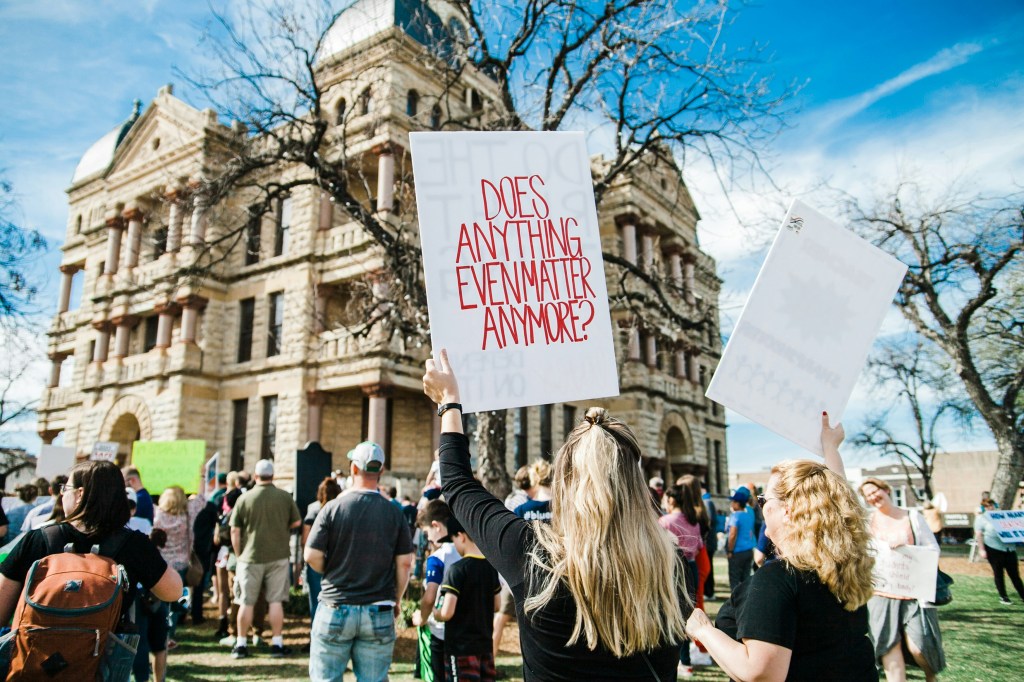
How can we call ourselves Christians
Saying that love is a tension
Between the call of the cross and
Between the old party line.–Citizens by Jon Guerra
Introduction
According to a 2023 Gallup article, “the more religious the individual in the U.S. today, the higher the probability that the individual identifies with or leans toward the Republican party.”[1] Meanwhile, the Republican Party continues to be dominated by Christian Nationalism which is a political movement that “affirms White supremacist assumptions and is largely exclusionary, authoritarian, and anti-democratic.”[2] Adherents fear “that a meek and humble Christianity will not do the job in the modern world and that the faithful now require an assertive and aggressive person to fight politically for their values.”[3] With 40% of Texas Christians adhering to or sympathizing with this political movement, many non-Christians are rightfully concerned about the separation of Church and State, claiming that one’s private faith has no place in the public square.[4] Many Christians agree and see politics as ‘too-worldly’. They choose to isolate themselves from politics as a whole, focusing on creating their own uniquely Christian cultures. How can the Church engage with the political world we live in without being dominated by it or isolating from it? I suggest that these are not the only options for Christian political engagement. The Church has an active role to play in the American democratic system and should embrace its mission as builders and cultivators for the common good. In this paper I will show that Christians are called to lives of political engagement, which we will see by looking at the allure of legitimation, the Christian Colony’s tendency to isolate, and lastly the Church’s mission as an embassy.
The Allure of Legitimation
In our current political moment, “the line between our political beliefs, our moral beliefs, and our theological beliefs is blurry, if not entirely invented.”[5] This blending creates real problems for Christians as they seek to determine the role their faith plays in their civic lives. Our democratic system of government, set up to allow the voices of the people to determine its roles and functions, allows Christians the opportunity to impose their value system upon the country at large. Consequently, one’s religious beliefs are often blurred with one’s political beliefs which is exemplified by the fact that Christians are influenced more by their preferred politician than their pastor. We’ve seen this playout in real time on the conservative side of the political spectrum. As Kaitlyn Schiess explains:
“Over the course of about twenty years, white American evangelicals solidified a particular approach to political engagement largely based in a partnership with the Republican party. This partnership moved from a strategic alliance (we’ll support your favored policies if you support ours) to a single coherence: Christian = Republican.”[6]
Over time, the legitimation of the political system by Evangelicals has opened the door for Christian Nationalism, a unique expression of faith and politics. Adherents to this movement “believe that the United States was founded as a Christian nation and that the government and its Christian citizens should take steps to keep it that way.”[7] They see political engagement as a way to promote “a social and cultural framework which seeks to marry a heavily constrained vision of Christianity.”[8] This vision “establishes and maintains a position of explicit privilege for Evangelicals and forces a strict adherence to a specific biblical worldview on non-adherents.”[9] Christian nationalism’s rise to power has been fueled by politicians as well as pastors openly encouraging their congregations to adopt the movement and its beliefs.[10] Evidence shows that due to support from the religious elite, “theological ideas . . . easily trickle down to and become absorbed by lay members of a faith community.”[11] This marriage of religion and politics has had disastrous affect on the faith of many professing Christians, leading half of Gen Z to claim that the Church’s support of Donald Trump has kept them out of the Church.[12] Though more attention has been on how the Right does this regularly, “both the conservative and liberal church, the so-called private and public church, are basically accommodationist . . . in their social ethic. Both assume wrongly that the American church’s primary social task is to underwrite American democracy.”[13] An interesting case can be seen in the 2026 race for the U.S. Senator of Texas where James Talarico, a Democrat, openly speaks about his faith and how it shapes his political platform. A seminarian himself, Talarico often uses the Bible and theology to justify his positions, finding support among many Texas Christians who are frustrated by the Christian nationalism seen in their state. Talarico represents a different option for Christians who have seen their faith co-opted for the seemingly cruel immigration policies, forced religious indoctrination, and political idolatry in the name of the Republican Party. However, the same inclination remains: having one’s political beliefs lead one’s religious beliefs. Michael Wear, the faith outreach director for President Obama’s 2012 election campaign, explains that in his attempt to offer a “different vision of Christianity and politics”, Talarico uses Scripture as justification for every issue of the Democrat platform: [14]
“This is the exact temptation when you combine faith and politics . . . that when you enter as an identifiable Christian voice or into a Christian political party, you aren’t just talking about the things that you want to talk about—you are forced to talk about a whole set of issues . . . and if you’re not careful, you risk claiming, as (C.S) Lewis would say, “God hath said when he hasn’t spoken.”[15]
Wear goes on to explain that Talarico’s methods (though he holds his religious beliefs in good faith) are identical to having religious voter guides in churches, a long-used conservative political strategy. This presentation acts as a litmus test, “ostensibly using faith, not politics, to set the criteria” when, in reality, it is actually politically driven.16 Though Talarico’s political posture and rhetoric differs from the militant and often cruel Christian nationalist movement, it shows that the tendency to marry religion and politics exists across the political spectrum. In our modern era, it is seemingly impossible to separate one’s politics from one’s religion and the former tends to lead the latter.
To their credit, Christians weary of the Right’s historic use of this political tactic are looking for something different. They are looking for a way to be politically engaged Christians without declaring allegiance to a specific Party. Talarico may represent a protest to the current religious elite’s idolatry, however, “we must make clear, not only through spoken word but also through embodied habit, that our political affiliations and commitments are tentative in light of our allegiance to Christ.”[17] With examples of legitimation on the Left and on the Right, it should come as no surprise that “political” has become a “dirty word”.[18] “It’s constantly pitted against the gospel, as if anything political stands in opposition to mere faithful living.”[19] This disdain for political engagement has led some Christians to choose a different option entirely: retreat.
Retreating to the Christian Colony
In their book, Resident Aliens: Life in the Christian Colony, Stanley Hauerwas and William H. Willimon critique the political idolatry of the American Church and cast a vision of the church’s role in the world. Their central thesis rests on the belief that the Church exists as a Christian colony and that Christianity “is an invitation to be part of an alien people who make a difference because they see something that cannot otherwise be seen without Christ.”[20] They claim that to be a Christian is to answer the “joyful call to be adopted by an alien people, to join a countercultural phenomenon, a new polis called church.”[21] Ultimately, Christians are called to be counter-cultural, radical even, but not radical in the secular sense. Hauerwas and Willimon argue that what “makes the church “radical” and forever “new” is not that the church tends to lean toward the left on most social issues, but rather that the church knows Jesus whereas the world does not.”[22] The Church as a Christian colony exists as a symbol to the world of a reality that is only possible through the death and resurrection of Jesus Christ. This colony is committed to Christ as King and not enslaved to the political powers of this world. It is in its radical nature to be a prophetic voice, speaking against the powers and principalities, and consistently calling out idolatry and hypocrisy regardless of which end of the political spectrum the accused resides. To be a Christian is to declare that God has the ultimate authority and is worthy of worship. The Christian Colony “is a political community by nature of it being a worshipping community.”[23] However, when this vision is applied, Christians have often taken this concept to the extreme, isolating themselves from the world and creating a colony separate from it. For them, they see the Christian colony as a place to retreat, viewing their religious beliefs as incompatible with the systems in which they live.
With countless examples of political abuse by the Church, it’s understandable that many Christians reject its political role completely. Those who choose isolation see politics as an unredeemable evil; one that has distracted the Church from its real mission. In an effort to reject political idolatry, the Church overcorrects, risking the abdication of its prophetic role as the hands and feet of Christ. This is why Hauerwas and Willimon’s vision is problematic. The Church cannot separate itself completely from the world without sacrificing its missional witness. According to Hauerwas and Willimon, “Christian politics has therefore come to mean, for both conservative and liberal Christians, Christian social activism.”[24] They argue “that the political task of Christians is to be the church rather than to transform the world.”[25] For them, ‘being the church’ is limited to a private, individual morality rather than a communally-lived, gospel existence. We see this clearly in the isolation camp’s understanding of ‘worship’ as being limited to prayer and song. Both these are vital to the Christian life, however ‘worship’ encompasses so much more than individual piety. In Romans 12:1, Paul encourages the church of Rome to “present your bodies as a living sacrifice, holy and acceptable to God, which is your spiritual worship.” (NRSV) In James 1:27, Christians are told that “religion that is pure and undefiled before God, the Father, is this: to care for orphans and widows in their distress.” As exiles in a foreign land, Christians are called to pray, yes, but also to seek the welfare of the land in which God has placed them, “for in its welfare you will find your welfare.” (Jeremiah 29:7) When the Christian colony exists as an excuse to avoid the messiness of the gospel, focusing on a private faith, the colony becomes a place for people to hide from the very people Jesus came to save.
Christians need to understand that “politics is so much more than just parties and elections.”[26] Being the Church is a call to embody the gospel; to make the gospel tangible in this world. We “can and should make the temporal world—which is a place for the workings of Satan and sin—a better place for life.”[27] Political engagement offers us endless opportunities to embody the life of Christ in our communities. This watershed moment, where political idolatry is so clearly on display, “means that we American Christians are at last free to be faithful in a way that makes being a Christian today an exciting adventure.”[28] Instead of retreating, we should embrace our roles as ambassadors, working for the common good as acts of worship. It is through this posture of worship that the Church exists as a light shining in the darkness, showing the love of God to a weary world. Ultimately, the Church is not called to be a colony. The Church is called to be an embassy.
The Church as Christian Embassy
As shown above, isolation and legitimation are incompatible for Christian political engagement. But before we continue, we need to define the word “political”. In her book, The Liturgy of Politics, Schiess explains that though the “word primarily indicates government functions—elections, legislation, court decisions, and so on”, Christians should look at political engagement in a more holistic way:[29]
“When we wake up in the morning, our eyes open in neighborhoods that are determined by politics. The racial and ethnic makeup of our communities aren’t an accident; they are greatly influenced by government decisions about zoning laws and a long history of legal segregation. The schools we attend are also implicated—local and national policies affect the opportunities our neighbors have access to. The stores we shop at are governed by policies that protect or neglect workers and businesses. The food we buy is influenced by policies that subsidize or regulate food industries. The cars we drive require gas, an industry with significant political implications for foreign policy and environmental law.”[30]
At the end of the day, everything is political. Politics is threaded throughout everyday life and impossible to avoid or ignore. With this understanding in mind, “politics” presents countless opportunities for Christians to love their neighbors as an outworking of their faith. In our democratic system, it is entirely possible for Christianity to “participate in a community’s sociopolitical life without thereby negating its spiritual essence and being taken advantage of for specific human ends, while at the same time supporting the moral development of the temporal world.”[31] As Jesus says in John 15:9, Christians are called to live in the world but not be of the world. Followers of Christ, are called to be creators of culture, stewarding the things of this world for the glory of God and seeking the ultimate flourishing of humanity. This cultural mandate is easier said than done, especially living in a pluralistic democratic system that relies on diverse people making different value claims and demanding quick, universal solutions. Therefore, the question remains, how do we do this faithfully?
In his ground breaking encyclical, Pope Leo XIV prophetically speaks to the dangers facing our current cultural and political moment. In Magníficas Humanitas, he urges the global Church to be builders that reject the allure of power, greed, and control that the world offers. Though his focus is on the Church’s stewardship of technological advances, the theology is relevant to Christian political engagement. Pope Leo offers two analogies for Christian engagement: the Tower of Babel (Genesis 11:1-9) and the rebuilding of the walls of Jerusalem in the book of Nehemiah (Nehemiah 2–6).[32] Christians can choose to be builders of Babel, worshipping power “that sacrifices the weak, a uniformity that neutralizes differences, and the pretense that a single language” is needed for peace.[33] Or, Christians can choose to be like Nehemiah and the returning exiles: slow building for the common good. He further explains that building:
“means recognizing that, precisely from the plurality of voices and visions which, even though they sometimes remind us of the confusion caused by the diversity of spoken languages, a bright possibility emerges. Indeed, this is the possibility of building together, of transforming diversity into a resource and of making listening and dialogue the common ground upon which to cultivate justice and fraternity. Within this shared task, Christians discover their unique role of guiding actions toward God so that, in his light, pluralism does not dissipate into disorder, but instead . . . it becomes the space in which humanity rediscovers its solid foundations and its final end.”[34]
“Building a world in which everyone can flourish requires shared responsibility and courage” and requires Christians to reject isolation, fully engaging with the world around them.[35] As builders for the common good, we can work within the political systems we find ourselves in without succumbing to party politics and political idolatry. Just like the returning exiles, we are all “given [our] own section of the wall,” working together to build for the common good.[36]
As ambassadors of Christ, we do not build in vain, even though we know that this side of Heaven will never reach perfection (2 Corinthians 5:20). We build as an act of worship to the King of Kings, where our true allegiance lies. As N.T. Wright suggests: “What you do in the present—by painting, preaching, singing, sewing, praying, teaching, building hospitals, digging wells, campaigning for justice, writing poems, caring for the needy, loving your neighbor as yourself—will last into God’s future.[37] All these choices are inherently political acts and in choosing to use one’s gifts for the common good, Christians are practicing political engagement. Ultimately, “social transformation requires consistency and integrity. People cannot promote values by which they do not live.”[38] This is how Christians can reject isolation and legitimation: by choosing to take an active role in cultivating and stewarding for the good of our neighbors. What separates the Church from a secular vision of social activism is a gospel-centered self awareness that we can do nothing apart from Christ. “The church, by God’s grace, can inculcate in us a cruciform disposition of humility in which we use our gifts and resources to serve and empower others.”[39] As Bruce Riley Ashford suggests, the Church:
“is intrinsically political as it assembles weekly, gathering around the confession that the risen and ascended Christ is King. It nourishes our Christian identity and sends us out as public witnesses to Christ’s kingdom. It incubates the dispositions and virtues that advance the common good. In this way the church serves as a formation center for public righteousness.”[40]
By rejecting legitimation and isolation, the Church becomes an embassy, representing the Kingdom of God in a foreign world, declaring its allegiance to Christ, and seeking the flourishing of all humanity.
Conclusion
We are living in an era where Christians and non-Christians alike are asking, “what is the role of religion in politics?” In post-Christian America, the urge to legitimize or isolate is strong. Some Christians fall prey to political idolatry, using politics for power, control, and coercion. Some abdicate their role by decrying political engagement completely, missing opportunities to love their neighbors and seek the welfare of their communities. Both options are unsatisfactory and are ultimately missing the radical call of the Church to be the hands and feet of Christ. Throughout the history of the church, “God is always sending his people (e.g. Gen. 1; Matt. 28), preparing us to bring the gospel into an interface with new contextual realities.”[41] As an embassy, the Church invites Christians “into worship to nourish our mission-political identity so that it can send us back into the world.”[42] Christians are sent into communities where they embody the reconciling love of Jesus Christ in word and in deed, creating a counter-cultural reality. This becomes an act of worship. Ultimately, the Christian calling is to get political, in the sense that we are called to shine light into dark places, cast the vision of the redeemed world that is to come, and invite others into an other-wordly community – all for the sake of the gospel. The task of American Christianity is to reject the “Babel Syndrome” and choose to build a world that supports the common good of all humanity. In this way political engagement acts as an invitation into the Kingdom of God, not by force or coercion but through love, service, and hope.
Bibliography
[1]Frank Newport, “Politics and Religion,” Gallup (blog), September 8, 2023, https://news.gallup.com /opinion/polling-matters/510464/politics-religion.aspx.
[2]Samuel L. Perry et al., “Fill the Earth and Subdue It: Christian Nationalism, Ethno-Religious Threat, and Nationalist Pronatalism,” Sociological Forum 37, no. 4 (December 2022): 1001.
[3]Ruiqian Li and Paul Froese, “For the Power or the Glory? The Religiosity of America’s Religious Nationalists,” Socius: Sociological Research for a Dynamic World 11 (2025): 11.
[4] Public Religion Research Institute, “Fact Sheet: A Closer Look at Christian Nationalism in Nine States,” PRRI, March 11, 2026, https://prri.org/spotlight/fact-sheet-a-closer-look-at-christian-nationalism-in-nine-states/.
[5]Kaitlyn Schiess, The Liturgy of Politics: Spiritual Formation for the Sake of Our Neighbor, foreword by Michael Wear (Downer’s Grove, IL: InterVarsity Press, 2020), 23.
[6]Schiess, The Liturgy of Politics, 7-8.
[7]Nilay Saiya, “The Varieties of American Christian Nationalism,” Politics and Religion 18, no. 2 (2025): 171.
[8]Joshua T. Davis, Samuel L. Perry, and Joshua B. Grubbs, “Liberty for Us, Limits for Them: Christian Nationalism and Americans’ Views on Citizens’ Rights,” Sociology of Religion 85, no. 1 (Spring 2024): 61.
[9] Saiya, “The Varieties of American Christian Nationalism,” 171.
[10] Ibid., 172.
[11] Ibid., 173.
[12]Ryan Burge and Rick Richardson, “Half of Gen Z Says Trump Support Keeps Them Out of Church,” Religion News Service, July 20, 2026, https://religionnews.com/2026/07/20/half-of-gen-z-says-trump-support -keeps-them-out-of-church/.
[13]Stanley Hauerwas and William H. Willimon, Resident Aliens: Life in the Christian Colony, expanded 25th anniversary ed. (Nashville: Abingdon Press, 2014), 32.
[14]Aaron Renn, “What Religious Left?,” ARC Magazine, July 14, 2023, https://arcmag.org/what-religious-left/, paragraph 14.
[15]Renn, “What Religious Left?,” paragraph 16.
[16] Ibid., paragraph 17.
[17] Bruce Riley Ashford, “Tayloring Christian Politics in Our Secular Age,” Themelios 42, no. 3 (December 2017): 449.
[18] Schiess, The Liturgy of Politics, 8-9.
[19] Ibid., 8-9.
[20] Hauerwas and Willimon, Resident Aliens, 24.
[21] Ibid., 30.
[22] Ibid., 28
[23] Oliver O’Donovan, The Desire of the Nations: Rediscovering the Roots of Political Theology (Cambridge: Cambridge University Press, 1996), 47.
[24] Hauerwas and Willimon, Resident Aliens, 37.
[25] Ibid., 38
[26] Dennis P. Petri, “Political Advice from Three Great Christian Political Philosophers,” Evangelical Review of Theology 46, no. 3 (2022): 256.
[27]Andrzej Słowikowski, “The Dialectic of Christian Politics: The Kierkegaard-Maritain Model,” Forum Philosophicum 28, no. 2 (2023): 365.
[28] Hauerwas and Willimon, Resident Aliens, 17.
[29] Schiess, The Liturgy of Politics, 15.
[30] Ibid., 15-16.
[31] Słowikowski, “The Dialectic of Christian Politics,” 361.
[32] Pope Leo XIV, Magnifica Humanitas [Encyclical Letter on Safeguarding the Human Person in the Time of Artificial Intelligence], Vatican, May 15, 2026, sec. 7, https://www.vatican.va.
[33] Ibid., sec. 10
[34] Ibid., sec. 10.
[35] Ibid., sec. 13.
[36] Ibid., sec. 13.
[37] N. T. Wright, Surprised by Hope: Rethinking Heaven, the Resurrection, and the Mission of the Church (New York: HarperOne, 2008), 193.
[38] Petri, “Political Advice from Three Great Christian Political Philosophers,” 225.
[39] Ashford, “Tayloring Christian Politics in Our Secular Age,” 450.
[40] Ibid., 448.
[41] Ashford, “Tayloring Christian Politics in Our Secular Age,” 449.
[42] Ibid., 449.






Leave a comment